09 March 2026



09 March 2026
If your organisation is evaluating managed mobility options, you've probably been presented with a carrier-aligned service that promises to handle your fleet end-to-end. On paper, it looks comprehensive. In practice, there are gaps that only become visible once you read the fine print — or once the invoices start arriving.
Carrier managed mobility offerings — like Vodafone's Managed Enterprise Mobility (MEM), powered by Mobilise IT, or Telstra's partner ecosystem through providers like OneStep Group — generally cover the operational side of fleet management well. That includes MACD support (moves, adds, changes, disconnections), asset tracking and device lifecycle management, end-user support portals and apps, and basic reporting within their own carrier environment.
For organisations running a single carrier, this can be adequate. The challenge emerges when your fleet spans two or more carriers — which, for most Australian enterprises of any scale, it does.
Key takeaway: Carrier-aligned managed mobility services handle operational fleet management — MACDs, asset tracking, device lifecycle, and support. These capabilities are table stakes, not differentiators.
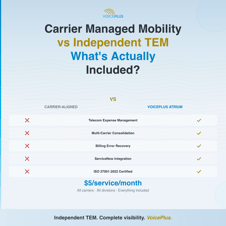
Telecom expense management is often a separate product. Vodafone MEM does not include telecom expense management, multi-carrier billing consolidation, or proactive cost optimisation as standard inclusions. These capabilities require a separate subscription to a platform like Brightfin — a US-based third-party tool — which adds another vendor, another contract, and additional cost on top of the MEM modules. You're now managing a managed service.
Multi-carrier visibility doesn't exist. Neither carrier-aligned option provides a single consolidated view of spend across both Telstra and Vodafone. If you need to report total fleet cost by division or cost centre across carriers, that reconciliation falls back on your internal team — creating the administrative burden you were trying to eliminate.
Cost optimisation is structurally limited. A carrier-aligned partner will optimise within their own carrier's plan catalogue. They won't benchmark across carriers, identify where a competitor's bolt-on is cheaper for a specific usage pattern, or flag when a service should move networks altogether. Independent billing error recovery — where a partner audits carrier invoices and pursues credits on your behalf — is typically not part of carrier-managed offerings.
IDD analysis falls through the cracks. For organisations with international operations, IDD spend is one of the largest and most overlooked savings levers. Without independent analysis of calling patterns by country and carrier, overspend accumulates month after month with no visibility.
Key takeaway: The most valuable managed mobility capabilities — TEM, multi-carrier consolidation, independent cost optimisation, and billing error recovery — are typically not included in carrier-aligned services and require separate third-party subscriptions at additional cost.
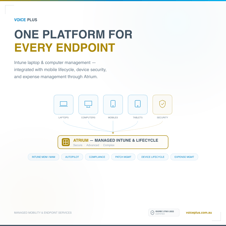
VoicePlus' Atrium platform was purpose-built to address exactly these gaps. At a flat $5 per service per month, the standard service includes procurement and support across all carriers, proactive telecom expense management and cost optimisation, multi-carrier billing consolidation in a single dashboard, independent billing error recovery with credit tracking, IDD spend analysis by country and carrier, native ServiceNow integration (not a bolt-on — a built-in plugin), asset register API sync with CMDB and ERP systems, automated HR-driven lifecycle management for joiners, movers, and leavers, and monthly governance meetings with both the client and each carrier.
No hidden modules. No third-party subscriptions required. No higher-tier plan needed to unlock self-service access.
Key takeaway: VoicePlus' Atrium platform includes TEM, multi-carrier consolidation, billing error recovery, ServiceNow integration, and HR lifecycle automation in a single flat-rate price — capabilities that carrier-aligned alternatives charge separately for via third-party add-ons.
When evaluating managed mobility options, the most useful exercise is to list what's included in the base price and what requires add-ons, separate contracts, or additional vendors.
With a carrier-aligned model, you're typically looking at the MEM fee covering only the primary carrier's services, a separate Brightfin or equivalent subscription for TEM, a separate engagement for the secondary carrier's services, no consolidated reporting across carriers, and portal customisation and integrations as additional professional services.
With VoicePlus Atrium, the $5/service/month covers the entire fleet across all carriers and all divisions — including TEM, cost optimisation, ServiceNow integration, asset API sync, portal customisation (20 hours per year), and monthly governance meetings. The establishment fee is a one-off $2,500.
In our experience, organisations that do this total-cost comparison consistently find that the "cheaper" carrier-aligned option becomes more expensive — and more complex — once the full scope of requirements is mapped.
Key takeaway: A complete total cost of ownership comparison must include third-party TEM subscriptions, secondary carrier management fees, and integration costs. The carrier-aligned model often proves more expensive than a single independent provider covering the full fleet.
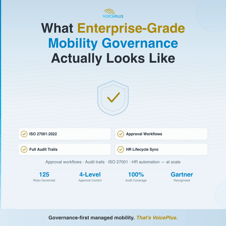
It's worth examining who's handling your fleet data. VoicePlus holds ISO/IEC 27001:2022 certification — independently audited by a JAS-ANZ accredited body, covering a full-scope ISMS across 125 identified risks.
By contrast, Mobilise IT holds ISO 9001:2015 (quality management, not information security), and OneStep Group has no publicly verifiable ISO 27001 certification. Being a partner of a certified organisation like Telstra or Microsoft does not confer that certification to the partner. Enterprise-grade security assurance comes from independent, accredited assessment — not commercial relationships.
Key takeaway: When evaluating providers, verify their ISO 27001 certification directly — check the certificate, scope, and accreditation body. Quality management certification (ISO 9001) is not equivalent to information security certification (ISO 27001).
VoicePlus is the only Australian company recognised by Gartner for its TEM and managed mobility platform — a distinction no carrier-aligned provider in this comparison holds. For procurement teams evaluating options, independent analyst recognition provides a credible benchmark beyond vendor self-reporting.
Key takeaway: Gartner recognition and peer-reviewed ratings provide procurement teams with independent validation when comparing managed mobility providers in the Australian market.
The most effective way to evaluate managed mobility options is to map your full requirements against what each provider includes in their base price — and what requires add-ons, separate contracts, or additional vendors. The gaps almost always appear in TEM, multi-carrier consolidation, and independent cost optimisation.
See how Atrium compares for your fleet →
Related reading:
FAQ — Carrier vs Independent Managed Mobility
What is the difference between carrier-aligned and independent managed mobility? Carrier-aligned managed mobility is provided by or through a telecommunications carrier, managing only that carrier's services. Independent managed mobility operates across all carriers without a revenue stake in any network, enabling unbiased cost optimisation, consolidated billing, and cross-carrier governance.
Does Vodafone MEM include telecom expense management? No. Vodafone's Managed Enterprise Mobility (powered by Mobilise IT) covers operational fleet management — MACDs, asset tracking, device lifecycle, and end-user support. Telecom expense management, billing consolidation, and proactive cost optimisation require a separate Brightfin subscription at additional cost.
What is included in VoicePlus' $5/service/month pricing? The flat rate covers procurement and support across all carriers, TEM and cost optimisation, multi-carrier billing consolidation, billing error recovery, ServiceNow integration, asset register API sync, HR-driven lifecycle automation, portal customisation (20 hours/year), and monthly governance meetings. No add-on modules or third-party subscriptions required. Learn more about Atrium →
Does Mobilise IT hold ISO 27001 certification? No. Mobilise IT holds ISO 9001:2015, which covers quality management — not information security. VoicePlus holds ISO/IEC 27001:2022, independently audited by a JAS-ANZ accredited certification body with full organisational scope.
How does VoicePlus compare on Gartner? VoicePlus is the only Australian company included in Gartner's Market Guide for Telecom Expense Management Services and is listed on Gartner Peer Insights for verified enterprise reviews. See Gartner recognition →
3 Strategies to Reduce Telecom Cost