20 August 2026



20 August 2026
Satellite-to-mobile is the most hyped corner of Australian telecommunications right now — and the gap between what's marketed, what's demonstrated, and what's actually deliverable keeps widening. Here's our assessment of where things genuinely stand, separated into four buckets: what exists, what's been demonstrated, what's legislated (or proposed), and what remains vendor ambition.
Telstra is the only Australian carrier with a commercial satellite direct-to-cell service. Satellite Messaging launched in June 2025 — 2.9 million customers have since sent more than 26 million texts — and Select Satellite Apps followed in July 2026, adding low-bandwidth access to WhatsApp, Messenger, Signal, Maps and weather apps on compatible devices.
The limitations are as important as the capability. The service supports no native voice calls, no Triple Zero access by any means, and Telstra explicitly warns it isn't designed for real-time applications. It's a genuinely useful safety-net layer — not a coverage substitute.
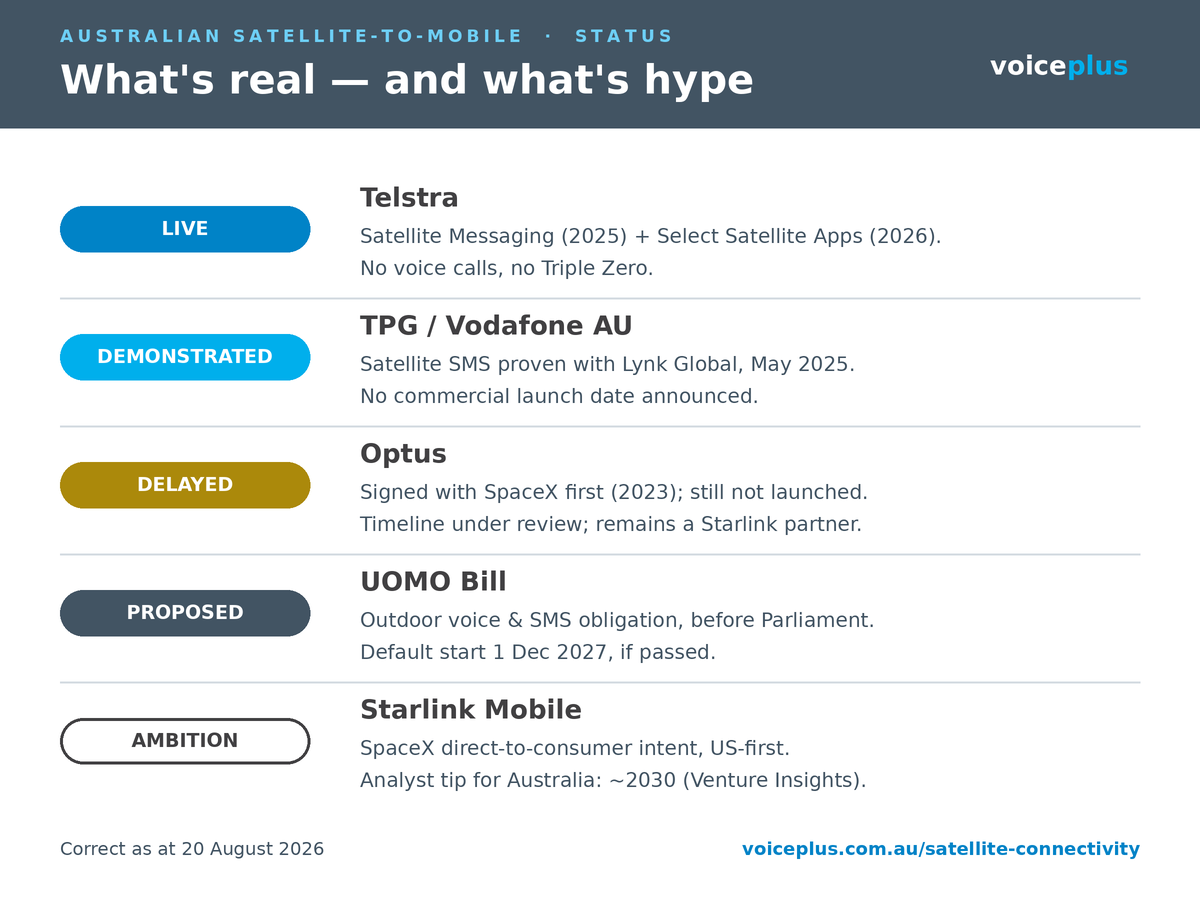
TPG Telecom's Australian satellite partner is Lynk Global, with successful direct-to-standard-smartphone SMS testing over the Vodafone network completed in May 2025. No commercial launch date has been announced.
Separately — and often conflated with TPG's position — Vodafone Group internationally has partnered with AST SpaceMobile, whose BlueBird constellation is designed to deliver genuine broadband to unmodified phones (Vodafone demonstrated a space-based video call in January 2025). But AST's deployment schedule has slipped, with New Glenn launch setbacks in 2026 pushing expectations for broader commercial service into 2027. AST is not TPG Australia's announced partner.
Optus was actually first to sign with SpaceX, in July 2023, targeting satellite SMS by late 2024 and voice/data by late 2025. Those targets slipped — a combination of US regulatory processes and technical constraints, with the relatively high-frequency spectrum available to Optus reported as a complicating factor for voice. As at August 2026 Optus has not commercially launched and is re-evaluating its timeline, though Starlink's Australian site continues to list Optus as a partner network alongside Telstra.
Optus is also leading a consortium building a sovereign Australian LEO satellite (built by Inovor Technologies in Adelaide, targeting launch by early 2028) — a sovereign space-capability project, distinct from its direct-to-mobile plans.
The Federal Government's Universal Outdoor Mobile Obligation would be a world-first: requiring Telstra, Optus and TPG to provide reasonable access to baseline outdoor voice and SMS almost everywhere in Australia — addressing roughly 5 million square kilometres currently without coverage — with carriers expected to combine terrestrial networks and LEO direct-to-device technology.
Three things worth understanding clearly:
It isn't law yet. The bill was introduced in November 2025 and remains before the House of Representatives, with debate continuing over the definition of "reasonable access" and whether it's premature to legislate for satellite voice before the technology exists at scale.
It covers voice and SMS only. Mobile data is not part of the baseline obligation — the Government has flagged it may be considered later.
The timeline is a default, not a deadline. Commencement is set at 1 December 2027 under the proposed legislation, with mechanisms allowing adjustment.
Already in force, meanwhile: since 30 June 2026, ACMA's coverage-map standard requires all three operators to publish standardised 4G/5G maps in four categories, updated quarterly. Under the new methodology Telstra's mapped footprint reduced by roughly 860,000 square kilometres — a mapping change, not a network change, but one that helps explain carrier enthusiasm for satellite as coverage backfill.
SpaceX signalled in its August 2026 earnings communications an intent to become a full mobile provider — "Starlink Mobile" — including terrestrial infrastructure. That's primarily a US strategy today. For Australia, the relevant forecast is analyst opinion: Venture Insights expects a standalone Starlink mobile offer could reach Australia around 2030. SpaceX has announced no such date. Gartner, for its part, forecasts ANZ LEO direct-to-device connections growing from 251,000 in 2025 to 1.52 million in 2027.
Three practical takeaways. First, if your fleet is on Telstra, satellite messaging capability is already in your users' pockets — but device compatibility, plan eligibility and (especially) emergency-calling limitations need to be understood before field teams rely on it. Second, if you're on Optus or Vodafone, satellite-to-mobile remains a future capability — plan accordingly. Third, for sites needing dependable voice and data beyond the network today, dish-based Starlink with WiFi Calling remains the deliverable answer, and the UOMO timeline (2027 at the earliest, if legislated) shouldn't change that calculus.
VoicePlus tracks this landscape as part of our carrier management and managed mobility services — so our customers make decisions on what's real, not what's announced.
Want this analysis applied to your fleet? Book a satellite connectivity review →
Only Telstra, with Satellite Messaging (June 2025) and Select Satellite Apps (July 2026). Optus has signed with SpaceX but not launched; TPG has demonstrated SMS with Lynk Global with no commercial date.
No. The bill was introduced in November 2025 and remains before Parliament. If passed, the default commencement is 1 December 2027, covering outdoor voice and SMS only.
SpaceX has signalled direct-to-consumer ambitions, primarily in the US. Analyst firm Venture Insights forecasts a possible Australian offer around 2030; SpaceX has announced no date.
Full FAQ and service details: Satellite Connectivity at VoicePlus
3 Strategies to Reduce Telecom Cost