19 January 2026



19 January 2026
As Australian enterprises enter 2026, CFOs and CIOs face a familiar but intensified challenge: rising labour costs, pricing volatility, regulatory pressure, and increasing dependency on digital and mobile infrastructure — all while being asked to protect growth and resilience.
Gartner’s 2025 Cost Optimization and Operational Flexibility Framework reinforces a critical shift in thinking: cost optimisation is no longer about cutting spend. It is about repositioning costs to protect value drivers, improve performance, and invest in future advantage.
At VoicePlus, we see this play out daily across telecom estates, mobile fleets, IoT deployments and endpoint environments. Connectivity and device ecosystems have quietly become one of the largest, least governed cost centres in most enterprises — and one of the most powerful levers for sustainable optimisation.
Gartner’s research highlights a common trait among what it calls “efficient growth companies”: they do not treat cost as something to minimise. They treat it as a strategic resource to be continuously reallocated toward differentiated capability and future growth.
These outperformers consistently:
Invest in capabilities that create competitive advantage
Reallocate resources toward growth-driving initiatives
Maintain cost discipline without sacrificing agility
Embed cost consciousness into daily decision-making
In the modern enterprise, this mindset must extend beyond traditional IT and procurement. Telecom, mobility, cloud connectivity, and endpoint management now sit directly in the path of revenue, operations, compliance and customer experience.
Mobile services, data plans, IoT SIMs, carrier contracts, and device estates often grow organically — across business units, geographies and suppliers — with limited central visibility. The result is:
Duplicate services and inactive connections
Out-of-contract carrier pricing
Misaligned plans and pooled data
Devices still incurring costs after staff or assets are decommissioned
VoicePlus helps enterprises move from reactive cost cutting to governed, continuous optimisation through:
Telecom Expense Management (TEM) — real-time visibility of carrier billing, contract terms, and service utilisation across all networks
Automated service validation — identifying inactive, underutilised or misallocated services
Carrier and vendor negotiation support — leveraging multi-carrier benchmarking to improve pricing and contract terms
This directly supports Gartner’s guidance to avoid blanket cuts and instead prioritise reductions based on strategic value and operational impact.
🔗 Learn more: https://www.voiceplus.com.au/services/telecom-expense-management
Gartner emphasises the need for organisations to identify and protect their “differentiating costs” — investments that directly enhance competitive advantage — while cutting underperforming initiatives.
In regulated and operationally intensive environments, performance is increasingly tied to:
Reliable mobile and field connectivity
Secure, compliant device fleets
Fast onboarding and offboarding of staff and contractors
Predictable service delivery across locations
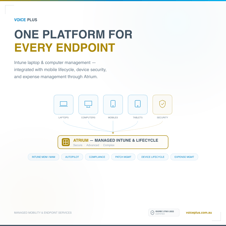
Through its Managed Mobility and Endpoint Services, VoicePlus enables organisations to:
Standardise device procurement and onboarding workflows
Enforce security, encryption and configuration policies via UEM/MDM
Integrate service and support workflows into ITSM platforms
Maintain a real-time, auditable asset register
This aligns with Gartner’s focus on process reengineering and automation — replacing manual, fragmented workflows with governed, system-driven operations.
🔗 Learn more: https://www.voiceplus.com.au/services/managed-mobile-computer-services
Gartner warns against cutting long-term growth engines such as AI, automation and digital platforms in the name of short-term savings.
For most enterprises, the communications and device estate is a foundational digital platform. It underpins:
Field operations and frontline productivity
Customer engagement and service delivery
Data capture, analytics and IoT systems
Security and regulatory compliance
VoicePlus helps organisations turn their mobility and connectivity environments into strategic, data-driven platforms through:
Lifecycle analytics and dashboards — understanding total cost of ownership, risk exposure and performance trends
Compliance-by-design frameworks — aligning device and supplier governance with ISO/IEC 27001 and ACMA expectations
Scalable onboarding models — supporting growth, acquisitions and workforce change without operational friction
🔗 Learn more: https://www.voiceplus.com.au/services/device-lifecycle-management
One of the most overlooked insights in Gartner’s framework is that poor governance is itself a cost driver.
Unmanaged devices, unauthorised suppliers, and fragmented contracts increase:
Financial leakage
Security risk
Regulatory exposure
Operational downtime
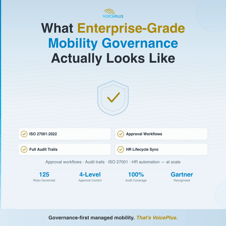
VoicePlus aligns enterprise mobility and telecom governance with ISO/IEC 27001:2022 controls and Australian regulatory expectations, including ACMA requirements, by embedding:
Authorised supplier and device frameworks
Secure onboarding and decommissioning processes
Asset ownership and accountability models
Audit-ready reporting and evidence trails
🔗 Learn more: https://www.voiceplus.com.au/services/device-security
Gartner’s core message is clear: optimisation is not a one-time program — it is an always-on leadership discipline.
Organisations that treat connectivity, devices and digital infrastructure as strategic assets — rather than overhead — gain:
Stronger financial control
Higher operational resilience
Better compliance posture
Faster innovation cycles
In a volatile economy, this becomes a competitive advantage, not just a cost-saving measure.
VoicePlus is an independent, multi-carrier Managed Mobility and Telecom Expense Management provider supporting enterprise and government organisations across Australia and New Zealand.
Aligning Gartner’s 2025 Framework with Telecom, Mobility and Endpoint Governance
By VoicePlus Data Pty Ltd
Attribution: Inspired by Gartner’s 2025 Cost Optimization and Operational Flexibility Framework and commentary by Alexander Bant.
3 Strategies to Reduce Telecom Cost